V/A: Hate-Ashbury—Freedom on the RISE, 1965-1970,
(Or, a short sampler of the three volumes:)
With
Martha Marcy May Marlene making the cinema rounds, once again that old ghost of the Zeitgeist, Charles Manson, rears his ugly, oddly compelling head. Not that there's anything romantic about a megalomaniacal cult pimp con guru partly responsible for mass murder. Or you could say that's precisely what there is: nothing more than romanticism to his rebel's legend. Chaos does seems to call to us, its sweetly morbid drone always a guilty pleasure (the death drive, blah, blah). But regardless of any juvenile fascination with Manson, there is a legitimately enduring relevance to the whole «Manson Family» tale, and the era it both epitomised and, in a way, put an end to.
Baby boomers, modern day hippies and fancy dress outlets tend to cast the '60s as a time of hit or miss fashion laced with well-meaning, communally held ideals that were scuppered at best, a little naïve at worst—a societal emancipation set to assuaging, innocent music. But if the music wasn't always that soothing, even the gently strummed philosophical lullabies of the age could contain something decidedly raging.
Bob Dylan's mystically paranoid «
A Hard Rain's a-Gonna Fall» spun apocalyptic visions on the back of the
Cuban Missile Crisis. Then there's his pacifist's assault, vicious and vindictive, on the
masters of war:
And I hope that you die
and your death'll come soon
I will follow your casket
in the pale afternoon
And I'll watch while you’re lowered
down to your deathbed
And I'll stand o'er your grave
'til I'm sure that you're dead
And that was in 1963. The counter-culture hadn't even begun.
Manson himself sang and wrote songs a lot less vitriolic. They were greatly admired by
Neil Young. One was recorded by
the Beach Boys. Manson's partner in crime and alpha coyote rival out there in the desert, Orkustra guitarist Bobby «Cupid» Beausoleil, provided the inspiration for the moniker behind his former band
Love. That was before he starred in forgotten soft porn classic
Ramrodder, scored
Kenneth Anger's «
Lucifer Rising» and stabbed a kindly
music teacher to death. The Buddhist and, according to one true crime writer, «successful bagpipe musician»
Gary Hinman had been held hostage in his own home for three days by Beausoleil, Susan Atkins and Mary Brunner. Manson made a short appearance to chop the captive's earlobe off with a machete. Two days later, once Beausoleil had stabbed Hinman twice in the chest, Atkins suffocated him with a pillow, perhaps to stifle his last ditch chanting of
«Nam-myo-ho-renge-kyo, nam-myo-ho-renge-kyo…»
Four years earlier, in 1965, Manson hanger-on Catherine «Gypsy» Share, then going under the assumed artist name of Charity Shayne, had released «
Ain't It?, Babe», a catchy jingle jangle single cheerily gloating over a former lover's misery. In 1971, she robbed an arms store in a bid to stock up for the hijacking of a plane, in a scheme to free Manson, by then convicted and imprisoned. One hostage would be killed for each hour that passed until Manson and his incarcerated cohorts were released. But the preliminary robbery ended in a shootout with the police that left Charity wounded, arrested and sentenced to five years.
There's also Beausoleil's former band mate,
Arthur Lee, who is rumoured to have been prone to pistol waving antics himself, threatening the life of friends in fits of freakout. And
Alexander «Skip» Spence—guitar player for
Quicksilver Messenger Service, drummer for
Jefferson Airplane and co-founder of
Moby Grape—tried using an axe to get through band mates Jerry Miller and Don Stevenson's hotel room, «Here's Johnny!» stylee. Not to mention
Sly Stone. In the year of our love 1967,
Sly & the Family Stone was touted as the great black-and-white hope: the first interracial band in the US. That claim must surely be untrue, but the band's marketing would have it that they were the personification of peace, love and civil rights. Stone, however, started growing fond of a bit of the old ultra-violence, to some of his band mates' lack of immediate personal safety. Stone is said to have let various incorrigible jailbirds and parasitical pimps, all with an unhealthy obsession with
A Clockwork Orange, into his inner circle. There came the night, apparently, when bassist Larry Graham had to flee his hotel room for fear of his life. One of the band's roadies didn't make it out, receiving a gratuitous beating. And that was the end of Sly's Family.

One of the things Manson took from growing up in prison was polarised race relations. He had a fear of black people, not helped by the formation of the militant Black Panther Party in 1966. Elaine Brown started out as a rank-and-file member, cleaning the Panthers' guns, but later became the party's first female Chairman. In 1969 the Panthers commissioned her to record an agitprop album,
Seize the Time, which features
the Black Panther anthem. A few years later, the badly beaten body of Brown's assistant, Black Panther bookkeeper
Betty Van Patter, washed up on a San Francisco beach. Van Patter had discovered irregularities in the Panther's books, just as Brown was running for councilwoman. When Brown published her memoirs—tellingly titled
A Taste of Power—she wrote that Van Patter had been a convicted drug dealer. These claims were omitted from later editions when it was revealed they were complete fabrications on Brown's part. Suspicion has fallen on her for ordering the unsolved murder. «All's fair in love and war»—an idiom seemingly tailored for the '60s.
And of course there's the Altamont Free Concert: Hell's Angels stabbing a raving, gun flailing teenager to the strains of mean spirited rant of resentment and control, «
Under My Thumb» by
the Rolling Stones. The Stones had flirted with being «the bad Beatles» for so long, by 1968 they'd added songs inspired by
Albert «Boston Strangler» DeSalvo,
Lee Harvey Oswald and
revolt to their already defiant repertoire of misogyny, androgyny and, less convincingly,
Satanism. Sample lyric:
I'm called the hit-and-run raper in anger
The knife-sharpened tippie-toe
Or just the shoot 'em dead, brainbell jangler
You know, the one you've never seen befo'
So if you ever meet the midnight rambler
coming down your marble hall
Well, he's pouncing like a proud black panther
Well, you can say I, I told you so
To clarify, should there be any confusion or subtlety, Jagger-Richards sign off with, «I'll stick my knife right down your throat, baby, and it hurts!» In hindsight, «Midnight Rambler» sounds prescient. The worst part is that the song is the Stones at their musically most pounding, grinding, crawl-on-your-knees
sexy.
Only five months before Altamont, Stones multi-instrumentalist Brian Jones, who scored the film
A Degree of Murder and even played saxophone on the Beatles' «
Helter Skelter», had been found floating—or rather, not floating—in his pool. It was the first of many '60s rock star deaths, and to some a suspected homicide. Moreover, Mick Jagger had scored the template for «Lucifer Rising», Anger's «
Invocation of My Demon Brother» (also starring Beausoleil, as Satan). He also appeared on
Dr. John, the Night Tripper's schlock hoodoo album
The Sun, Moon & Herbs. And so naturally, when Hell's Angel Alan Passaro stabbed
Meredith Hunter, the
Grateful Dead—long-time champions of the Hell's Angels, who had recommended using the biker-rapists as festival security in the first place—were quick to blame the disaster on all the karmic indiscretions of the Stones. No sympathy for the Devil, then. The Dead even went on to compose a couple of strangely chipper-sounding ditties about the misadventure.
The original hippies, who had thought they could change the Hell's Angels, were unable to grasp what had happened, what was happening and what has always been happening:
I spent a little time on the mountain
I spent a little time on the hill
Things went down we don't understand
but I think in time we will
But even before Altamont, in 1968, the
MC5 caused a violent, but as luck would have it not death-inducing riot, when they played impresario Bill Graham's New York venue, the Fillmore East. The gig was organised in conjunction with a hippie militia of sorts—a no-nonsense, anarcho-Dadaist street gang with revolutionary pretensions called
the Motherfuckers. (Motto: «We will be free or we will not be.») In the inimitable cattiness of A&R man Danny Fields,
… the Motherfuckers were a radical East Village group who had been demanding that Bill Graham turn the Fillmore East over to them one night a week because it was in the «Community.» My favorite word, the «Community.» They wanted to cook meals in there and have their babies make doody on the seats. These were really disgusting people. They were bearded and fat and Earth motherish and angry and belligerent and old and ugly and losers. And they were hard. …
So they booked a Thursday night, and to placate the Community five hundred tickets were given to the Motherfuckers to distribute to their fat, smelly, ugly people. (Cf. Please Kill Me—The Uncensored Oral History of Punk.)
But when the supposedly militant
White Panthers of the Motor City Five arrived in a limo, the radicals' sensibilities were upset. The Motherfuckers kicked the jams out of them. Guitarist Wayne Kramer had to fend off a knife attack, while Graham had his nose broken with a chain. Literally adding insult to injury, the Motherfuckers screamed that the MC5 were «Pigs!»—the same dehumanising, vaguely anti-establishment epithet that would later be scrawled in the blood of Gary Hinman,
Wojciech Frykowski and
Leno LaBianca by Bobby Beausoleil, Susan Atkins and Patricia Krenwinkel.

Also in 1968, one of the Motherfuckers' affiliates, the warped but brilliant
Valerie Solanas, shot
Andy Warhol in his lungs, spleen, stomach, liver and esophagus, killing him… for a while, until doctors managed to bring him back from clinical death. Solanas also shot critic-curator Mario Amaya in the hip, and tried to blow Warhol's manager's brains out, failing only because her gun jammed. Warhol, of course, had previously produced mythic speed reprobates
the Velvet Underground (
and Nico), bank rolling their S&M flavoured brand of queer junkie hipster rock, which is easily dated to the '60s, though far from summery or lovely.
It's not fair to say that hippies went from being deluded peaceniks to confused and rabid animals that, in some nightmarish collapse of innocence, had to come to terms with their own all too human nature. Hippies were the «original punks» and all that, scuzzy well before 1969. There's even evidence of it in the music. Especially in garage rock—a genre that could be as spitting and vindictive as the worst of them—but also in folk rock, abounding with gleefully sung
Schadenfreude and apocalyptic visions, and in chart topping psychedelic pop, milking ideological trends or espousing corny, surprisingly foresighted cautionary tales. These days, New Age vegans who like to see
Che Guevara as the Communist with a heart of gold fail to recognise that the '60s quest for realisation delivered people into occult fancies, armed revolution and violent psychosis, as much as Hare Krishna centres,
macrobiotic dieting and nirvana. One account of the Manson troupe's move from San Franscisco would have it that Haight-Ashbury, with its overwhelming influx of runaways, on-the-runs and parolees, was becoming too unsafe. For the Mansons. That love was free doesn't mean it couldn't be stolen.

The progression of the 1960s isn't some cautionary tale, nor a romantic one. The mythic aura surrounding grim reaper of love Manson and his band of creepy, crawly midnight ramblers is in no small part due to the wealth and celebrity of some of their victims. Serial killers prey on the poor, and speedfreaks, crackheads, et al. do unspeakable things to one another (and their loved ones) all the time. They're not relegated to the history books for it, nor are they taken to bookend eras. Manson and Altamont provided a neat ending for those subscribing to the superstition that round numbers are somehow significant. That a decade must come to some sort of narrative end. 1969 was seen as worse than '67 or '68 because 1970—that new morning—was fast approaching. The horrors and mishaps of 1969 are taken as omens, as the failure of peaceful hopes and dreams. This in a decade where the mainstream was involved in daily carnage in Vietnam, Cambodia and Laos, and even in ghettos, universities and, in some countries, secret prisons.

All this is not to be morbid. In all its history, music never seemed to matter as much, collectively speaking, as in the 1960s. The belief in its transformational powers, along with its inextricable links to political events and views, have never been paralleled, before or since. The music of the '60s doesn't merely say something about taste and aesthetics. (These days, politics in popular music is limited to people getting annoyed at Bono and
that guy from that band that had that song about the eye of the tiger in Rocky III who sued Newt Gingrich for using the song without their consent.)

Here, then, is a three-disc historical document… that rocks: A compilation sequenced more or less chronologically, tracing the trajectory from anti-war protest through personal and romantic resentment, to attempts at turning people on, to the boundary-crossing mysticism of transcendence and transgression, to calls for what Fields called «a very lovely and attractive, sweet revolution» and, finally, to murder and lunacy. It begins not only with hope, but also with queasy premonitions and various seeds of nastiness, ending in stabbings and schizophrenia. Sticking to chronology is better than imposing a selective progression in hindsight. The confusion this lack of narrative reveals is only fitting to the times. That said, the chronology also offers a glimpse into how perceptions, if not reality, developed. Deadly stabbings weren't invented in 1969, and it's only their connections to celebrities (Sharon Tate and the Rolling Stones) that made it seem so. The songs did become meaner, more militant or mentally unhinged as the decade raced along, hope giving way to disillusionment, psychout and loathing. And yet none of these are completely absent from the earlier songs. It wasn't love, but resentment that blossomed.

The music on this collection—some of it obscure, some of it chart topping—sums up the main ingredients of the '60s counter-culture: The desperate wish to love, even if and especially when resentment still lingers; disdain for the old order; the eagerness to break into new, unchartered, previously forbidden territory; the hubris that comes with strength in numbers; the apocalyptic fantasies of Judeo-Christianity (Heaven on Earth brought on by Hell on Earth); fascination with Eastern metaphysics (all is one, life and death are the same, kill your ego); anti-war pacifism; and, finally, when patience had run its course, revolutionary fervour. Some of the people who glowed the brightest—Skip Spence, Syd Barrett—were left muttering with paranoia, at once sad and creepy, profound and bullshit. Most of the bands had little or nothing to offer in the decade to come. Values had been upended, only for people to find that
some boundaries might have been in order. Otherwise freedom is chaos, and chaos has no constraint. Chaos is violent flux and change—Patricia Krenwinkel hacking away as
Abigail Folger tells her, «You can stop now; I'm already dead.» Chaos is the kind of «freedom» that leaves 28 stab wounds in one body.

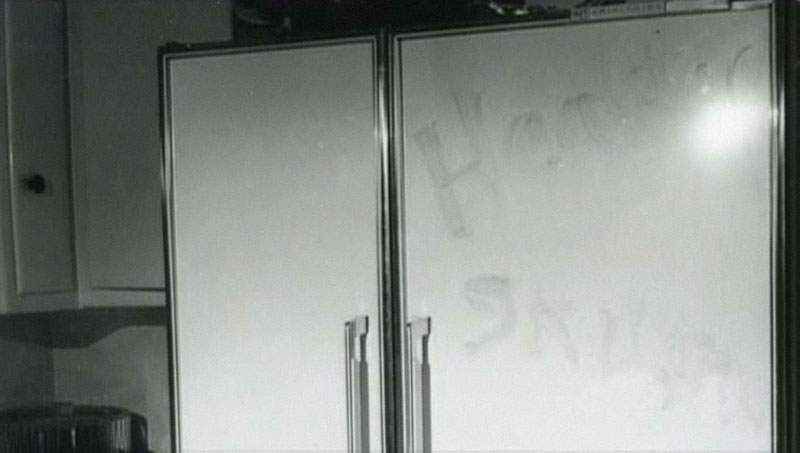
Krenwinkel wrote «RISE» in Leno LaBianca's blood, and that’s what it did: Rise, through the lumpenproletariat of Charles Manson up the middle class runaways, erupting finally in the Hollywood hills. Had the rich & beautiful bitten the hand that fed them? Or had they beaten their dog until it, finally, bit back? Was it the ghetto, the jailbirds and those exiled by the suburbs channelling their vengeance ever upwards—a downward spiral turned on its head, all trance and vertigo—straddling the shoulders of the bourgeoisie so they could strike at the head of society? A petty, powerless blow of great tragedy, no consequence and a value that was only ever symbolic, by now just a frivolous, callous pop culture reference? For all the rhetoric of love, the ambling, aimless seekers were still not getting anywhere. They were stuck with their humiliations, envy and grudges, the failures of their spiritual endeavours.
These guided the hand of Krenwinkel as she kept absentmindedly jabbing at Mr. LaBianca's corpse with a fork, playing with it, making the fork ping out of his abdomen (which had «WAR» carved on it), telling herself, «Now he won't be sending any of his children off to war,» stabbing him 'til she was sure he was dead.

 Welcome to the second instalment of Toilet Guppies' escapist series, Saturday Night, Sunday Late Afternoon, where voice and instrument collide to create a third eye, transforming the listener into a sightseeing astral traveller. (Tourist, if you must.) This time we're heading to the Orient. That's right, the Orient. A time when Hong Kong was still British, and India was the crown jewel of her empire. An era when most of Southeast Asia was known as French Indochina, the War on Drugs was called the Opium Wars and the Hippie Trail had not yet become the Banana Pancake Circuit. Forget the Taliban, al-Qaeda, the Arab Spring and the fact that everyone's big in Japan these days; we're going to a time before Gandhi, Mao, Edward Saïd and Sai Baba.


 Posts
Posts